


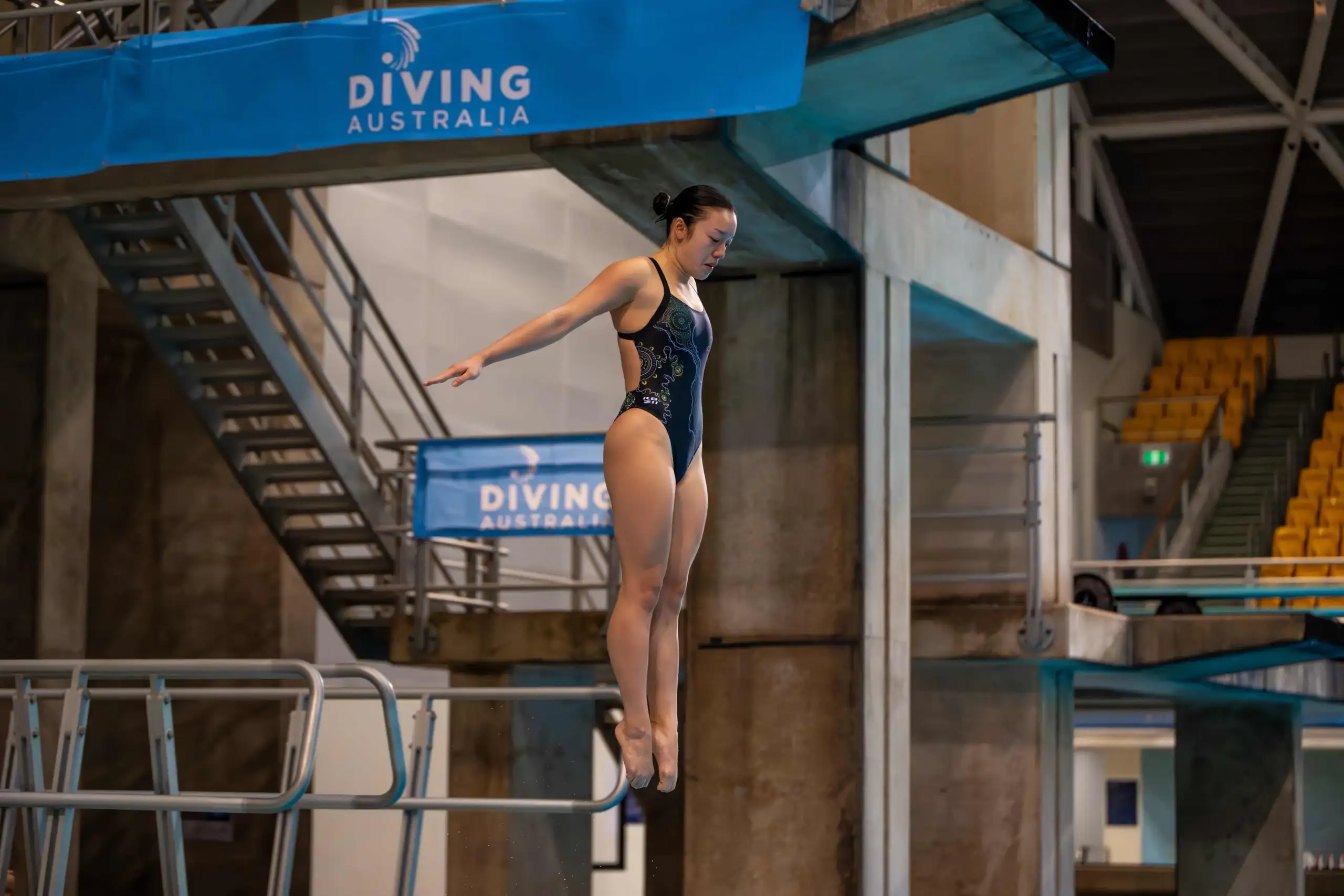
In the sport of diving, which pursues extreme precision and flawless technique, effort is a creed etched into every athlete’s DNA. But for VIS athlete and Australian diver, Nina Phan, and VIS Diving Coach, Rebecca Stafford, sometimes the key to success lies in learning to ‘try less’.
In training, every component of Phan’s dives; take off, aerial form, difficulty, and entry, was well executed when viewed in isolation.Yet strangely, these elements rarely came together organically to unleash their full potential in a single dive.
Phan and Stafford experimented with rating Phan’s perceived level of effort, with the results being surprising. Her best dives often occurred not when she was giving a nine or ten out of ten, but when she felt her perceived effort was only a three on the scale.
“Her talent far exceeded what I was seeing, so our biggest question became ‘why?’,” Stafford explained.
This question attracted the expertise of VIS Performance Scientist – Skill Acquisition, Ryan Hatfield.
Together, Hatfield and Stafford quickly identified the crux of the problem. When Phan was relaxed and inadvertently ‘trying less’, her movements were fluid, natural, and well-timed. When she consciously intensified her focus and overthought technical details, her movements became stiff and mechanical.
I understood the concept in theory, that trying to micromanage my actions during each step of the dive wasn’t helpful, but trusting it felt so counterintuitive in practice, Phan reflected.
“This is common with a ‘narrow, internal focus’ of attention,” Hatfield explained.
“Athletes can become so focused on internal body details like ‘are my arms moving fast enough,’ that they miss crucial external environmental information such as ‘how far away is the water?’. This prevents them from making fine adjustments based on real-time circumstances.”
From this, a new goal emerged.
Could Phan learn to trust her well-trained body, instead of constantly trying to command it with her conscious mind?
The team termed this approach ‘intuitive diving’ and decided to take a risk and test this approach at a national level competition, during the Australian Domestic Grand Prix.
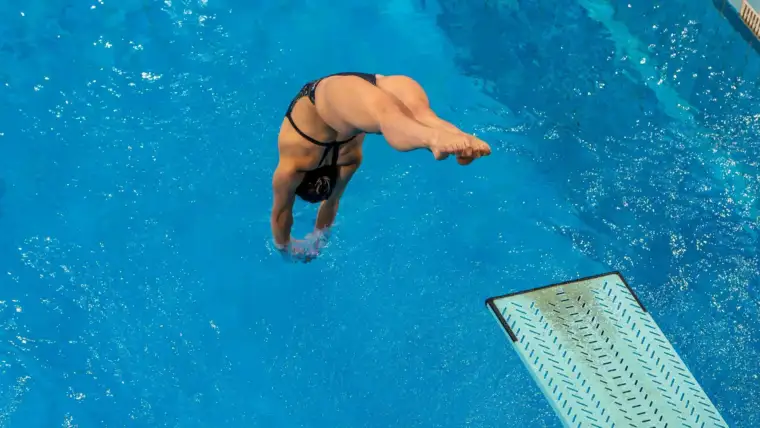
This posed a significant challenge for Stafford, who had to refrain from her instinct to provide technical instruction.
“The coaching I needed to provide wasn’t second nature. I had to be really conscious to not give technical feedback and use universal cues instead, which sometimes felt like I wasn’t doing my job,” Stafford admitted.
In that competition, Phan achieved a personal best score, proving the direction of the approach was correct. But Stafford’s next challenge was to continue identifying the best way to coach without relying on technical feedback.
After the competition, the team entered a period of highly creative exploration, adopting a dual-track training plan focused on separating technical sessions, and intuitive sessions.
The technical sessions focused on refining details using the traditional ‘internal focus’ model to address specific technical issues.
The intuitive sessions had a single goal where the focus was to ‘let go’. Stafford would provide no technical instruction, instead encouraging Phan to focus her attention externally. Working on developing broad cues that helped Phan focus on the whole dive, and fully trust her body’s intuition, allowing her to stay present.
“This is underpinned by the theory of the difference between learning and performance,” Hatfield said.
Technical sessions became detail oriented, for practicing specific performance details. Meanwhile intuitive sessions became mindset oriented, for transferring the technical details into a less detail oriented, more automatic mindset… a flow state, if you will.
They dedicated just 40 minutes per week (approximately 2.5% of total training time) to intuitive training, yet the effects accumulated steadily.
The biggest obstacle came from Phan’s deeply ingrained beliefs. In sports culture, mistakes are often equated with technical flaws that must be corrected through more focused technical thinking.
“During these sessions, if I did something that worked, I often got distracted trying to consciously replicate an outcome, like feeling more powerful, with physical actions rather than replicating the correct ‘intuitive’ mindset’,” Phan explained.
“When I was executing better dives with my intuitive mindset, it sometimes felt like a fluke or a coincidence because I didn’t feel as though I had done anything to improve my dives. Which I guess is the whole point.”
After a few of these instances, it started to become more obvious that performing intuitively, not focusing on good technical action, was contributing to these good performances.
Despite knowing this, it took a while to trust intuitive performance when the pressure was on and the team really wanted a good performance.
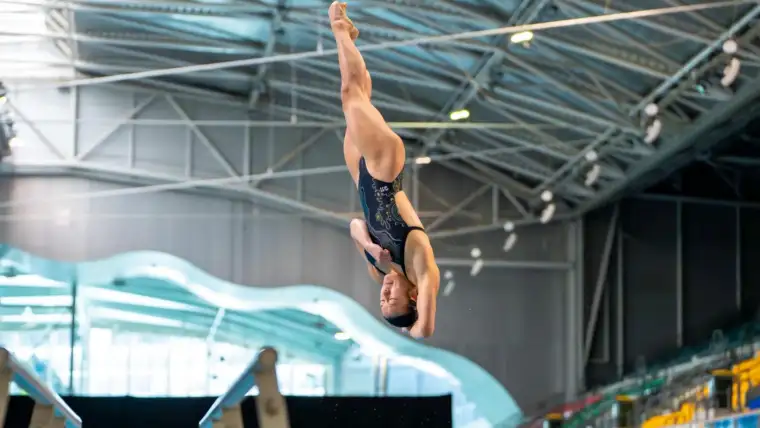
After six months of systematic training, Phan achieved a significant breakthrough at the Australian Senior National Championships.
She set new personal best scores in each round; preliminary-finals, semi-finals, and finals, improving her total score by a massive 70 points compared to six months prior.
An even more gratifying change occurred away from the pool. Phan, who was often completely focused during competitions, was able to relax away from the pool and find balance in her time between competitions.
“She told me she had gone for a walk on the beach in the evening and managed to do some studying between competitions,” said Hatfield, recalling his favourite memory from the whole project.
“Usually, her mind was completely filled with technical details before a competition. But this time, she felt prepared, equipped with the right mindset strategies, and the confidence that she could execute her dives intuitively when the time came.
Carrying this unprecedented sense of calm, she scored her first ever 300 points in the final. More importantly in the months that followed, her scores never dropped below 290, demonstrating remarkable consistency.
For Stafford, this was an alignment of her coaching philosophy and practice. It was a process of refining application, not redefining belief.
“What we challenged wasn’t just my personal coaching habits; we challenged the traditional coaching model of diving itself. It required trust, collaboration, and the courage to learn and coach in a way that aligns with an athlete’s individual learning style,” she said.
For Phan, the significance of this journey far surpasses medals and scores.
She found the balance between effort and intuition in performance, the equilibrium where she truly shines.
Images: Get Snapt/Mel Faull
By Xuanyu Hao (Melbourne University) & Kate Paul-Drevensek