
By Jamie McPherson, proud Wadawurrung man, Connection to Country Officer, Victorian Institute of Sport
The NAIDOC Week 2026 theme celebrates 50 years of the modern NAIDOC movement. It recognises five decades of Aboriginal and Torres Strait Islander strength, resilience and achievement, while honouring the activists, Elders and communities who have sustained and grown that legacy.
Working in high performance sport, I wanted to reflect on what those same 50 years have looked like for First Nations athletes. Not just the medals and the moments we all remember, but the people who opened doors, challenged barriers and changed what was possible for the generations that followed.
To tell that story properly, we need to acknowledge those who came before the fifty-year period itself, and the barriers they had to climb over just to compete.
The Cost of the Climb
Before NAIDOC became the national platform we know today, pioneers such as Kevin Coombs OAM, Percy Hobson, Adrian Blair, Frank Roberts and Michael Ah Matt were already breaking new ground, at a time when discriminatory laws and policies still shaped where Aboriginal people could live, work, travel and access opportunity. Coombs became Australia’s first Aboriginal Paralympian in 1960, travelling to Rome on an honorary British passport because Australia did not yet fully recognise him as a citizen.
Systemic racism, government control through reserves and missions, and limited support prevented many First Nations athletes from reaching elite amateur sport. Others, including world sprint champion Lynch Cooper and Australian middleweight boxing champion Jerry Jerome, were excluded from the Olympics because they competed professionally, often one of the few ways to earn a living and escape poverty.
When I look back at this history, what stands out is not the hardship itself. It is the determination shown in spite of it. Generation after generation, First Nations athletes continued to turn up, compete, succeed and create opportunities for those who followed. Their achievements laid the foundation. The next fifty years built the house.
Building Momentum
By the mid-1970s, Aboriginal and Torres Strait Islander athletes were becoming increasingly visible on the international stage.
Ray Barrett was setting world records in wheelchair racing while helping establish a proud First Nations presence within Paralympic sport.
In 1980, Danny Morseu became the first Torres Strait Islander Olympian, ensuring that both Aboriginal and Torres Strait Islander peoples could see themselves represented on the world’s biggest sporting stage.
These milestones mattered because representation matters. Every athlete who broke through made it easier for the next athlete to believe they belonged there too.
The momentum accelerated through the 1990s.
At Barcelona in 1992, Samantha Riley OAM became the first Aboriginal Olympic medallist. Just weeks later, Tracy Barrell won Paralympic gold, demonstrating that First Nations success was being realised across both Olympic and Paralympic sport.
Then came Atlanta.
In 1996, Nova Peris OAM became the first Aboriginal Olympic gold medallist as part of the Hockeyroos. Her achievement was historic, but what followed was equally remarkable. She later transitioned to athletics and became a Commonwealth Games champion, proving barriers could be broken more than once.
The Sydney Moment
For many Australians, and for many First Nations people, the defining sporting moment of the past fifty years arrived in September 2000.
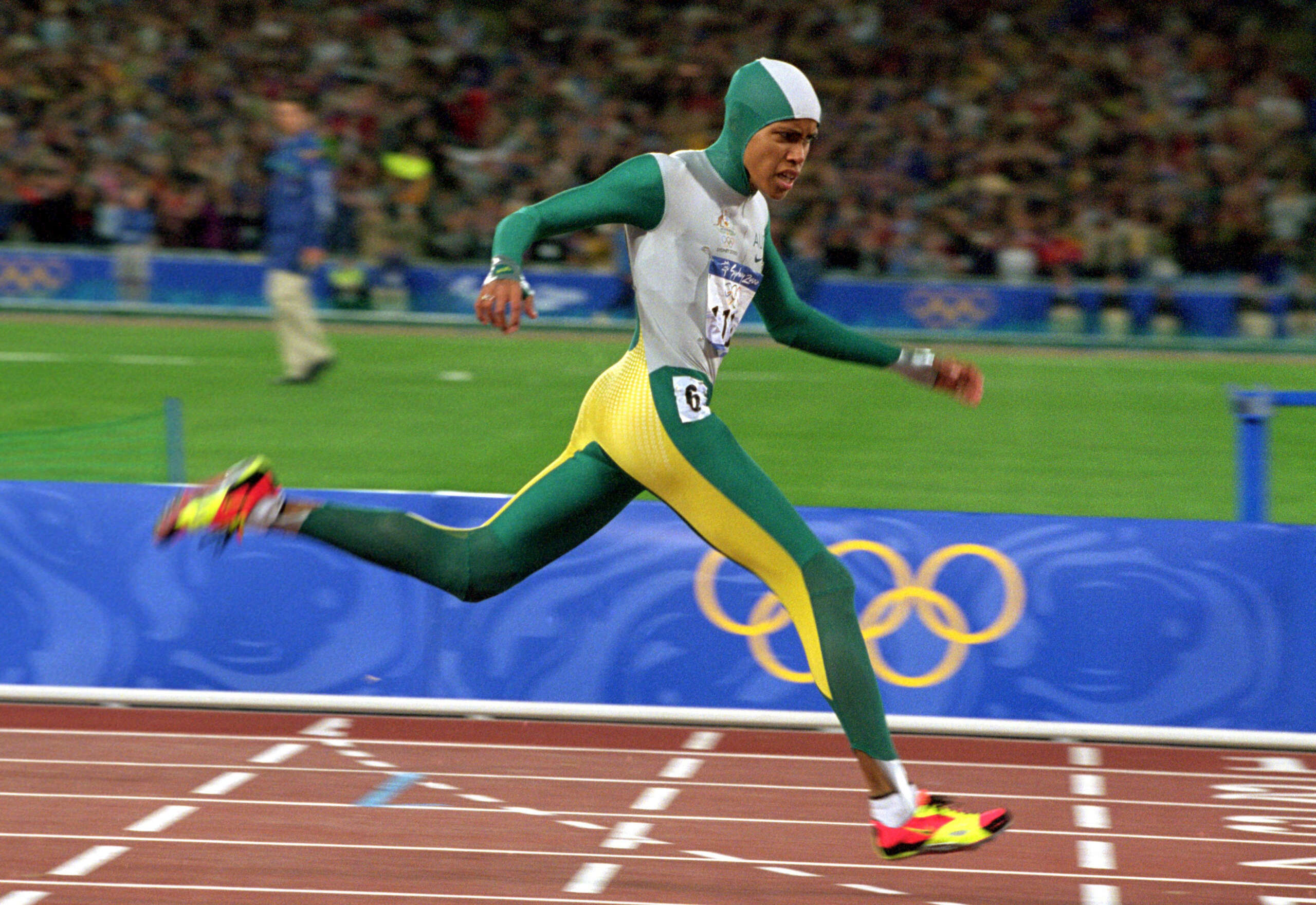
Before she would change the course of Australian sporting history and gain recognition with the highest Australian honours, Companion of the Order of Australia (AC). Cathy Freeman’s victory in the 400 metres at the Sydney Olympic Games transcended sport. It was a moment of pride, symbolism and possibility. A proud Aboriginal woman carried the hopes of a nation and delivered on the biggest stage imaginable.
Twenty-six years later, we still talk about that race.
The Growth of a Legacy
The years since Sydney have produced the broadest and most diverse period of First Nations representation Australian sport has ever seen.
At Tokyo 2020, Patty Mills AM became the first Aboriginal and Torres Strait Islander athlete to carry the Australian flag at an Olympic Games Opening Ceremony. Taliqua Clancy became the first Aboriginal and Torres Strait Islander athlete to compete in Olympic beach volleyball and later claimed an Olympic silver medal. Harley Windsor made history at the 2018 Winter Olympics in PyeongChang as Australia’s first Indigenous Winter Olympian and Amanda Reid OAM Australian Paralympian has represented Australia in swimming, cycling, and snowboarding winning a silver medal at the 2016 Rio Paralympics and gold medals at both the Tokyo 2020 and Paris 2024 Paralympics before becoming Australia’s first Indigenous Winter Paralympian.
Today, more than 80 Aboriginal and Torres Strait Islander athletes have represented Australia across Olympic and Paralympic competition.
That number tells an important story.
Not simply that more athletes are succeeding, but that stronger pathways now exist to support them. The opportunities available to young First Nations athletes today are greater than those available to previous generations, although there is still much work to do.
As someone who works at the Victorian Institute of Sport (VIS) creating pathways and breaking barriers for the next generation to succeed, the history doesn’t feel distant. The VIS proudly counts Freeman among its alumni, and to work in the same building where she trained and to walk through spaces connected to that legacy is a constant reminder that success never happens in isolation. Behind every champion is a pathway that somebody fought to create, and every generation inherits a responsibility to keep building on that work.
Looking Towards Brisbane 2032
The next great chapter is already approaching.
Brisbane 2032 will be a home Olympic and Paralympic Games held on home soil. The athletes who compete there will carry with them more than fifty years of growing First Nations representation and a much longer history of sporting excellence.
From Barrett and Morseu to Freeman, Mills, Reid and the many athletes emerging today, each generation is writing another chapter.
If the last fifty years have taught us anything, it is that First Nations excellence was never the question. The challenge has been ensuring that excellence is recognised, supported and given every opportunity to flourish.
That’s the work I turn up for today. As we look towards Brisbane 2032 and beyond, my hope is that the next generation of First Nations athletes won’t just benefit from the pathways created by those who came before them, they’ll help redefine what those pathways can become.
And as we celebrate fifty years of NAIDOC, I believe the next fifty years of First Nations sport may be even more extraordinary than the last.